
A product page may devote ten photographs to the dial and one to the underside of the bracelet. That reverses the amount of contact each part has with your body. A clasp presses against a desk, catches a cuff and determines whether a sized bracelet stays comfortable when your wrist changes through the day. It deserves more attention than the words ‘stainless steel’ usually give it.
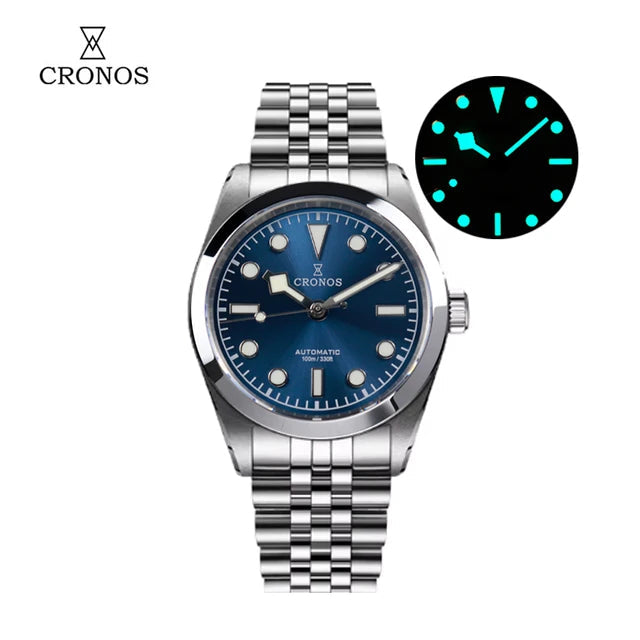
The Cronos 36mm Snowflake Automatic is a compact watch worth evaluating for fit; the San Martin SN0113W V2 gives a second point of reference. Our catalogue does not verify a clasp specification for either reference. That absence matters: it stops us promising a feature, such as on-the-fly adjustment, that may depend on a particular variant or production run. Inspect the actual configuration a seller offers.
Fit is a sequence, not a feature
First, size the bracelet so the watch head sits where you want it. Then look underneath: is the clasp centred, or did removing whole links leave it pulled toward one side? Half links, multiple adjustment positions and removable links on both sides can help, but their availability must be checked for the exact watch. If the only comfortable length puts the clasp off-centre, the watch may drift even when the case dimensions look ideal.
Next, move your wrist. Links that articulate smoothly can let the bracelet follow it; stiff links may make a small case feel larger. Check the first link after the lug and the edges where your wrist bends. Try the clasp at a desk and under a sleeve. A reassuringly firm closure is useful; a closure that needs painful force or opens accidentally is a problem. These are observations you can test, not qualities that follow automatically from price.
Finally, consider your habits. If your wrist expands in warm weather, adjustment range may matter more than elaborate finishing. If you wear the watch on straps, a mediocre supplied bracelet might be a tolerable compromise. If this is your only watch, spending more to get a bracelet you enjoy can make more sense than spending the same amount on a dial detail you notice only in photographs.
Owner accounts in the linked discussion repeatedly return to bracelets and clasps when describing the difference between price levels. Those accounts point to what to inspect; they do not prove that one brand always makes a better clasp. Ask for a photograph of the inside, the adjustment mechanism and the exact supplied bracelet before ordering. A good clasp disappears during the day. A bad one makes itself known every hour.
If you buy online, make your first inspection deliberate. Before removing protective film or shortening links, confirm what the seller will accept as a return. Then check alignment, closure and whether the adjustment options seem sufficient. You may still need to wear the watch to know for sure, but a careful first look can reveal a mismatch before you commit to sizing it.
A five-minute clasp check
- ✓Can you centre the clasp after sizing?
- ✓Is there enough adjustment for temperature changes?
- ✓Do edges catch skin, a cuff or the desk?
- ✓Do the first links follow the wrist naturally?
- ✓Does the closure stay secure without excessive force?