
Most people start shopping with a diameter cutoff — "nothing over 38mm," "nothing under 40." It feels like a solid rule, especially when you can't try the watch on first. But diameter only measures one direction across the case. The dimension that actually decides whether a watch overhangs your wrist is lug-to-lug — the span from one lug tip to the other. Plenty of watches marketed as "compact" surprise buyers here.
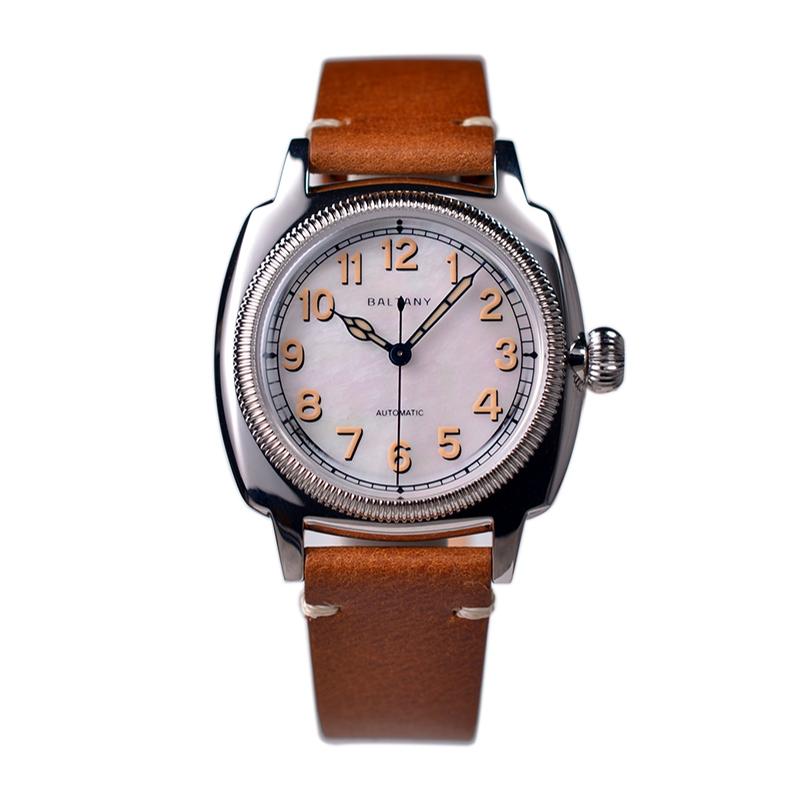
The catalogue gives a clean example of why this matters. The Baltany 1926 Oyster Tribute is 36mm across but 43.3mm lug-to-lug. The Militado ML05 Field Watch is 38mm across but 46mm lug-to-lug. Diameter alone would tell you the Baltany is meaningfully smaller. Lug-to-lug tells you the real gap in footprint is almost as big as the diameter difference suggests — so if you were choosing by diameter alone, you'd have gotten the size comparison roughly right by accident, not by using the right number.
Read the shape, not just the size
Check the lugs themselves. Downturned lugs curve the case in toward your wrist, effectively shrinking the footprint below what the lug-to-lug number implies. Long, straight lugs do the opposite — they can leave visible gaps even when the raw measurement looks fine. If the watch has a bracelet, check the end links too: an end link that projects past the case edge adds to the effective footprint in a way the spec sheet won't show you. Ask the seller for a side-profile photo, and for a bracelet watch, a photo showing the end links. A straight-on catalogue shot hides exactly the geometry that matters here.
Check thickness the same way. The Baltany and Militado differ in stated thickness too, but two watches with the identical thickness number can wear completely differently depending on how that height is distributed — a tall crystal that sits proud, a deep caseback that adds bulk underneath, or flat case sides versus curved ones. There's no formula that converts a thickness number into "how tall this will look on your wrist" — you have to look at the actual case profile.
| Compare | Baltany 1926 Oyster Tribute | Militado ML05 Field Watch |
|---|---|---|
| Reference price | USD 249 | USD 60 |
| Diameter | 36 mm | 38 mm |
| Lug-to-lug | 43.3 mm | 46 mm |
| Thickness | 8.9 mm | 10.5 mm |
| Bracelet / strap | Not published | Official supplied strap |
Use a watch you already own as your ruler
Your wrist measurement in millimeters only tells you the circumference — it says nothing about whether your wrist is broad and flat or narrow and rounded, and that shape changes how lugs land on it. So instead of trusting a generic "X mm wrist = Y mm watch" rule, measure a watch you already own and like: its diameter, lug-to-lug, and thickness, and note where the lugs actually sit relative to your wrist's edge. That known watch is a far better reference point than a stranger's wrist-size chart.
If you can get to a shop and try a similar case, put the strap on at the tightness you'd actually wear it — a loose strap lets the watch slide to a wider part of your wrist and can make it look smaller in a photo than it'll feel worn properly. Then move: rest your arm on a table, turn your wrist, look at it from the side. The moment you see it start to tip or rotate on your wrist tells you more than any static photo will.
The short version: use diameter to narrow your search down to a reasonable shortlist. Use lug-to-lug, case profile, wrist photos of people with a similar wrist shape to yours, and the seller's return policy to actually decide. A watch can be "correct" on paper and still feel too big in person — and one that looks small in the listing photo can feel exactly right. Diameter gets you started. Lug-to-lug and case shape are what actually decide whether you keep it.